The Feurle Collection, Berlin
7 July 2023 – 7 January 2024
by JOE LLOYD
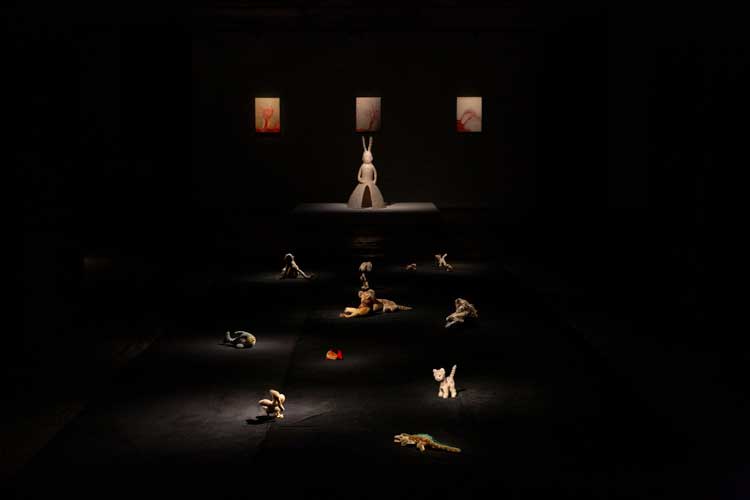
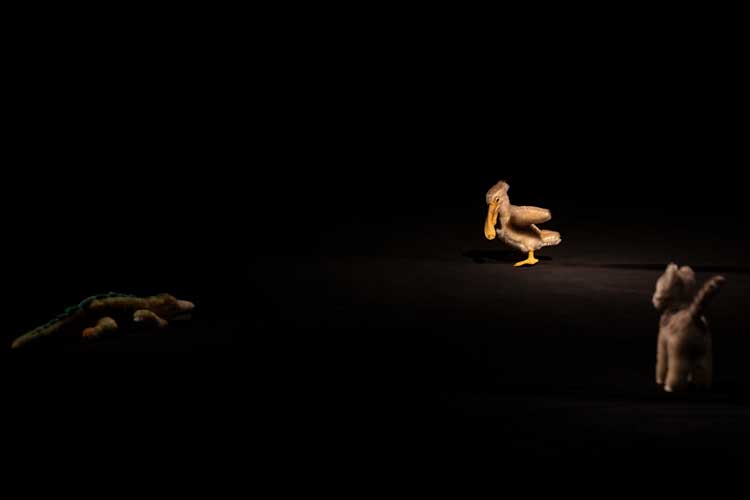
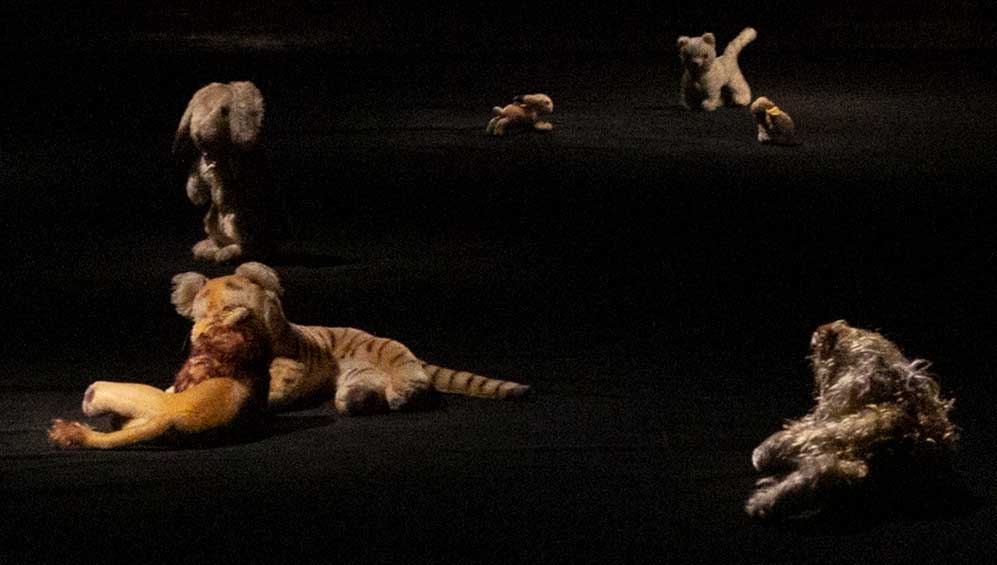
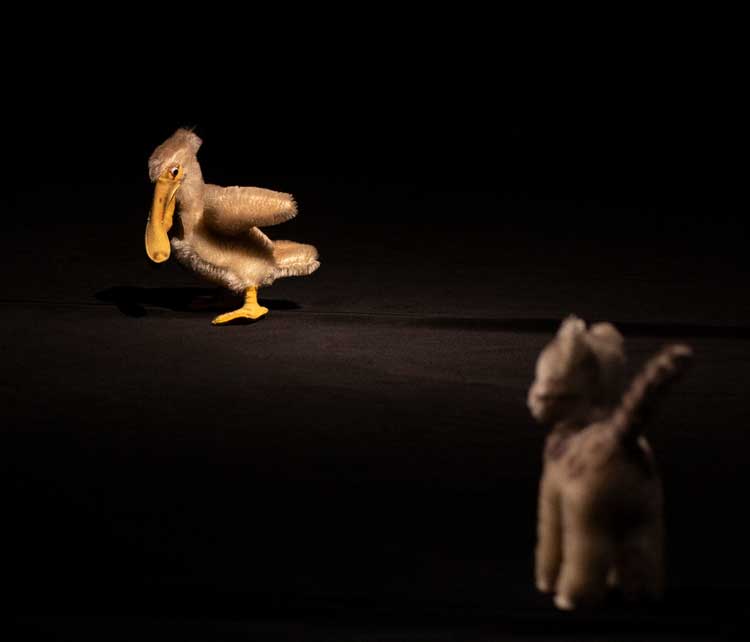
What do animals do at night, when people are asleep? In the exhibition When Animals Become Art at the Feuerle Collection, the Japanese-Swiss artist Leiko Ikemura (b1951) creates an enchanted moonlight garden of creatures. A striped kitten stares at a yellow-billed pelican, while a crocodile lurks in the darkness. A big blue fish communes with a smaller red relative. A lion and a tiger cuddle up. Overseeing them all is a half-human, half-hare hybrid in terracotta with ears that lift towards the sky like antennae. This is a Usagi (2022) (Japanese for “rabbit”), a figure that appears again and again in Ikemura’s work. Its long form connects the earth and the sky.
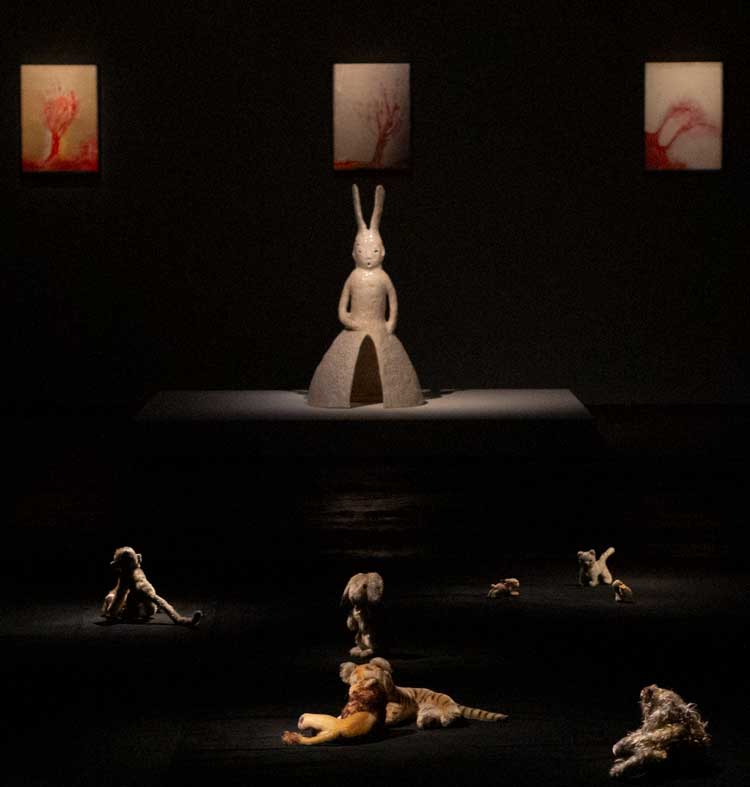
Ikemura is drawn to rabbits and hares because of their perceived relevance to people. She is also interested in their habit of darting in a zigzag motion, moving left then right to escape predators rather than taking the obvious, straight-ahead route. It is fair to say that this approach applies to this exhibition. It places several of Ikemura’s works together with a selection of secondhand stuffed animals from the artist’s vast collection. The animals were all produced by Steiff, the German company that created the first factory-produced teddy bear; today, they are renowned for their high-quality materials. The chosen toys are spotlighted in a darkened room, while Ikemura’s works surround them, with works on paper hung on the walls, and sculpture placed on luxuriant black cushions.
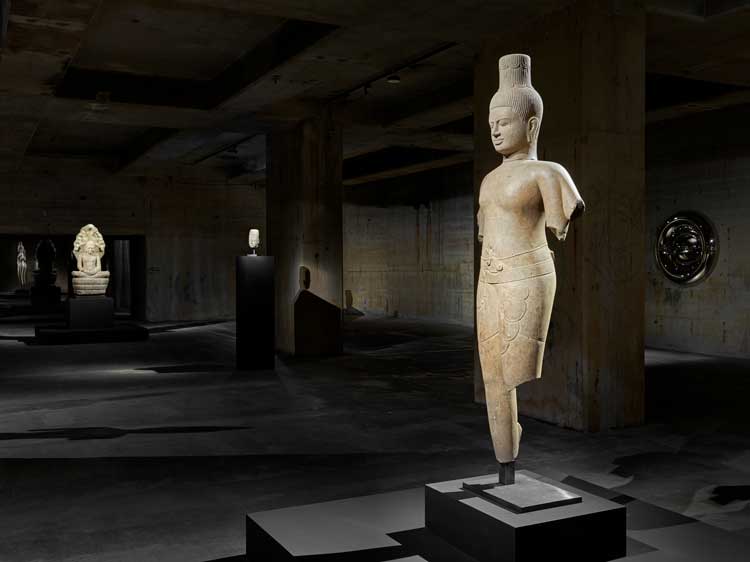
This aesthetic accords with that of the Feuerle Collection. The Feuerle is a rare thing in the overpopulated museum and galleries circuit, a true one-off. It is the passion project of the collector Désiré Feuerle. As a gallerist in 1990s Cologne, Feuerle became adept at pairing works by leading German artists with non-art objects, such as antique clocks, tea and coffee pots and scientific instruments; Ikemura’s Steiff collection joins a long line. And as a collector, Feuerle has focused on artefacts of east Asia – in particular, Khmer sculpture and Imperial Chinese furniture – as well contemporary artworks by Cristina Iglesias, Anish Kapoor and others.
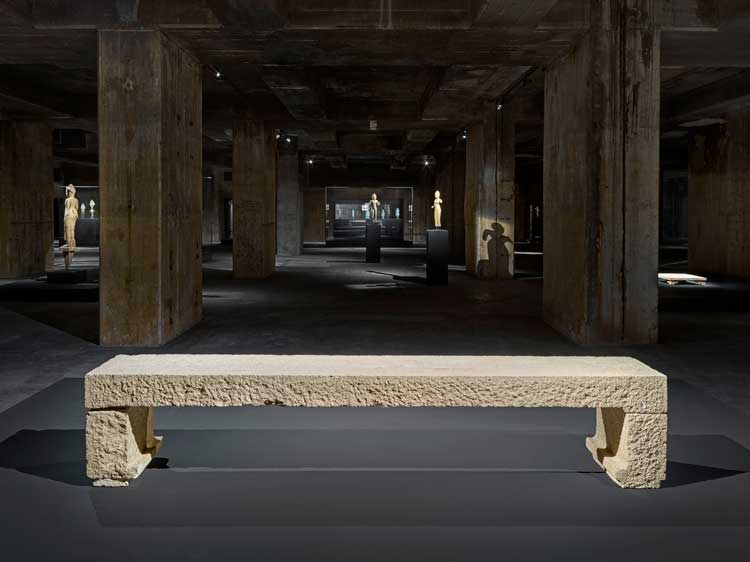
The Feuerle Collection displays some of these accumulated works to the public. It opened in 2016, after a long process of location-scouting. It occupies a second world war bunker on the side of the Landwehr canal, near where west once met east. It was designed to protect the city’s telecommunications authorities from allied bombs, but was never used. Left behind are cavernous spaces, including a vast basement that connects two ground-floor structures, and 2-metre-thick concrete walls. Feuerle commissioned the British architect John Pawson to renovate the building. The resulting scheme retains – and, indeed, highlights – the material qualities of the original construction, an austere monumental aesthetic that makes postwar brutalism seem airy by comparison.
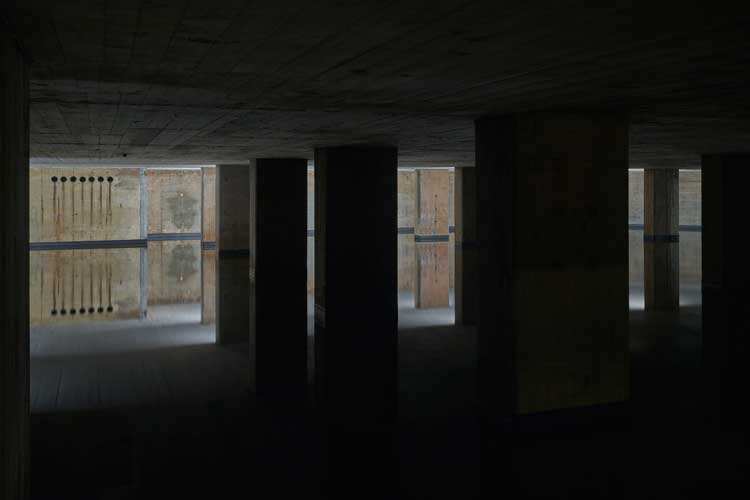
There are numerous distinguishing features. Phones are not allowed. Exhibits have no labels. There is a vast Lake Room, visible through glass, which has been flooded to resemble a minimalist version of Istanbul’s Basilica Cistern; it provides geothermal heat to the Collection. There is an Intense Room, where Feuerle has preserved the ancient Chinese tradition of the intense bath. But the single most characteristic aspect of the Collection is the light-level. On entry, you descend a staircase, then enter a room of pitch darkness where a John Cage composition plays. After the readjustment, you enter the collection’s basement. Individual artworks and objects are spotlit in the gloom, spaced out so that each stands on its own. Each is lit to perfection, so that every contour, impression or speck of colour can be seen. It makes you wonder whether all art should be displayed this way.
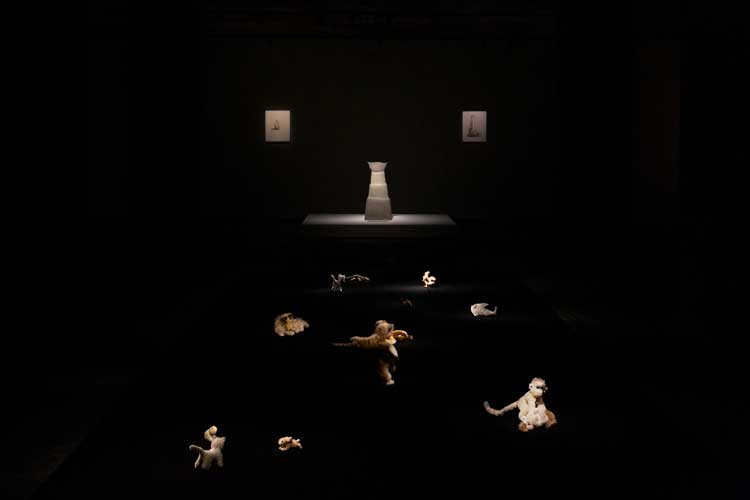
When Animals Become Art, the second temporary exhibition in a curtained-off section of the ground floor, is no exception. It was curated by Feuerle himself, with clear attention to detail. It is clear why Ikemura appeals to the collector. Her sculptures are patently contemporary artworks, but they draw on Japanese traditions. One papier-mache work placed on a cushion, Kitsune (“Fox”) Eating Colour (2021/23), is the delicate head of a human with two fox-ear like protrusions emerging from its hair. In Japanese folklore, kitsunes are shape-changers. This head could turn into a fox at any moment. Ikemura’s towering humanoid hare and the pagoda-esque Bride (1992), which stand on either side of the exhibition, have forms that could intermingle with the deities and furniture of Feuerle’s permanent collection.
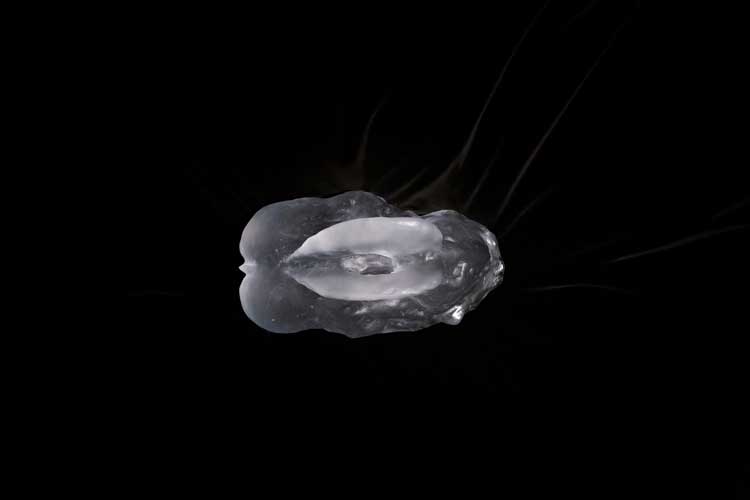
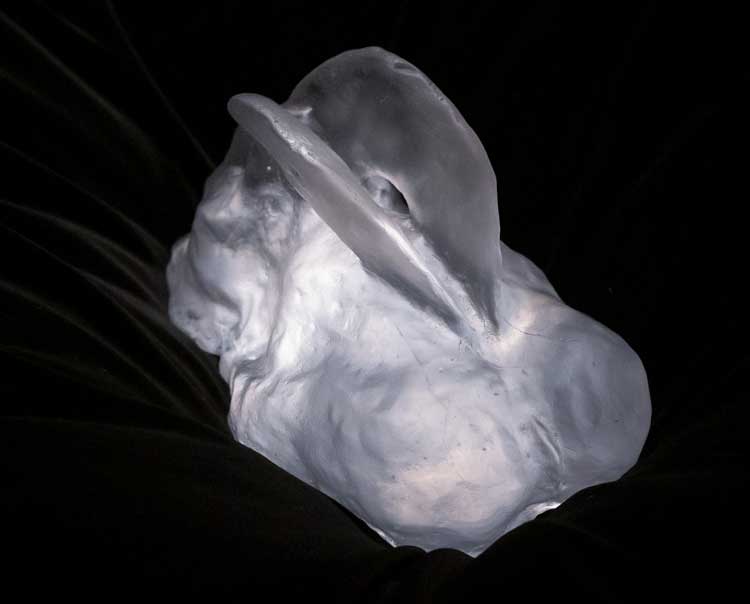
Unlike the ancient objects on display elsewhere, however, I find in Ikemura’s work a hint of menace. There is a secret world here, one of signs and symbols that only Ikemura’s hybrids can access. Behind the big Usagi, a series of paintings depict red trees (2013) against jaundiced yellow backgrounds. They are oddly fleshly, like flayed limbs. Is it just the light, or is this something more sinister? The Usagi itself stands as if conducting a ritual on the creatures below. Its gnomic face betrays no expression. Elsewhere, a smaller glass hare (2022) sits on a cushion like a precious human child. If the separation between human and other life is muddied, so is that between life and minerals. The patinated bronze Bride could be metal becoming a humanoid or a humanoid becoming metal, or both at the same time. Ikemura’s work encourages us to think all ways.
The stuffed animals sometimes seem as if they could spring to life in a flurry of violence, predators sinking their teeth into prey. This aliveness suggests that stuffed animals can indeed become art, at least if they are as well-crafted as the Steiff toys on display. As Ikemura says: “They start to be vivid, gain a life. They are innocent and they convey a certain melancholy because they have been touched and beloved, yet abandoned.” Under Feuerle’s spotlights, they acquire the presence of sculpture – a new life indeed.